Regulatory constraints, geopolitical alignment, and execution risk
Executive summary
Canada possesses substantial critical mineral resources but continues to face persistent challenges in converting geological potential into executable, competitive mining projects. These challenges are not primarily technical. They are regulatory, political, and geopolitical.
This brief examines Canada’s critical minerals position through three lenses:
-
Resource-to-reserve conversion constraints
-
Geopolitical alignment and supply-chain exposure
-
Execution risk across Arctic and non-Arctic jurisdictions
The central finding is that Canada’s competitive weakness lies not in discovery, but in project execution under layered regulatory, permitting, and geopolitical pressure.
1. Critical minerals and strategic competition
Critical minerals underpin advanced manufacturing, electrification, defence systems, and industrial automation. Control over extraction, processing, and access increasingly shapes state power and industrial resilience.
Canada’s critical mineral relevance is strongest in:
-
Nickel
-
Copper
-
Cobalt
-
Graphite
-
Rare earth elements
-
Uranium
These materials sit upstream of defence, energy, and technology supply chains, making mining projects strategically sensitive beyond their commercial profiles.
As global competition intensifies, mining assets are increasingly evaluated not only on cost and grade, but on jurisdictional reliability, alliance alignment, and downstream dependency.
2. Canada’s resource-to-reserve conversion problem
Canada’s primary mining constraint is not resource scarcity, but reserve conversion.
Key factors include:
-
Prolonged permitting timelines
-
Federal and provincial regulatory overlap
-
Indigenous consultation sequencing risk
-
Cost inflation and infrastructure deficits
-
Investor sensitivity to delay and political discretion
As a result, capital allocation often favours brownfield expansions and life-of-mine extensions over greenfield development. While this preserves near-term production, it limits long-term capacity growth and supply responsiveness.
3. Midstream dependency and geopolitical overhang
Canada remains exposed to global refining and processing bottlenecks, particularly for critical minerals where midstream capacity is concentrated outside allied jurisdictions.
This exposure creates:
-
Financing risk for upstream projects
-
Vulnerability to export controls or informal restrictions
-
Policy-driven uncertainty affecting project economics
Geopolitical overhang does not operate solely through formal trade agreements. It emerges through processing concentration, strategic industrial policy, and alliance pressure shaping capital flows.
For mining projects, this translates into elevated non-technical risk even where geology is strong.
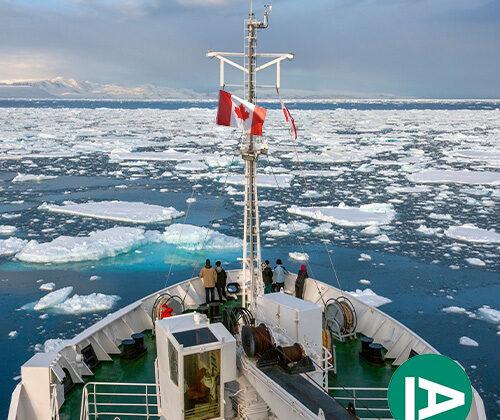
4. The Arctic dimension: Access as a constraint
Canada’s Arctic resource base is strategically significant but operationally constrained.
Key limitations include:
-
Seasonal access windows
-
Icebreaker availability and capacity
-
Underdeveloped transport and power infrastructure
-
High capital intensity for first-mover projects
Infrastructure investments in Arctic corridors, ports, and communications can improve feasibility, but they do not eliminate execution risk. Mining viability in the Arctic remains closely tied to state-backed infrastructure development and long-term policy continuity.
5. Capital, regulation, and execution risk
From an investor perspective, Canadian mining projects increasingly face a trade-off:
-
High jurisdictional stability
-
Elevated regulatory and timeline risk
This dynamic favours:
-
Incremental brownfield investment
-
Shorter-cycle projects
-
Jurisdictions with clearer execution pathways, even where political risk may be higher
Without structural improvements in permitting clarity, infrastructure delivery, and processing capacity, Canada risks underperforming relative to peers in critical mineral development.
6. Implications for policy and industry
For policymakers:
-
Strategic mineral policy must address execution, not discovery
-
Infrastructure, permitting coordination, and processing capacity are decisive
For industry:
-
Non-technical risk assessment is central to project viability
-
Geopolitical alignment and supply-chain exposure must be priced into development decisions
Canada’s critical minerals future depends less on what exists underground than on the political, regulatory, and geopolitical systems governing extraction and delivery.
From the author
This brief reflects a non-technical risk and governance perspective on mining projects, drawing on political science, communications, and geopolitical analysis applied to resource extraction and supply chains.